 back home
blog git:(main)
Google IO Hackathon
May 24, 2026
My experience at a one-day hackathon hosted by Google Deepmind and Cerebral Valley
Google IO Hackathon
At 3:30 in the afternoon, with less than 2 hours before our project was due, we realized we were running into severe rate limits with our Google managed agents. These weren't one-time issues either. It felt like every other request stalled, and we could never figure out what was causing the problems, because everything ran in a sandboxed cloud environment, with no way to monitor progress. We had to pivot the entire agent architecture---literally the only requirement of the hackathon theme: Use gemini-3.5-flash to make something new. And not to mention, my Codex limits had just hit 25% when we decided to pivot.
You can probably imagine how stressful that was. I was left juggling a quarter of my 5-hour limit, for arguably the most important change. But before that, I want to explain how I got here.
I applied to the hackathon on the day I saw the post on X. I am always so hyped for Google IO, and I was like, it would be so cool if I actually got into their hackathon. I feel IO is where Google releases what they have been cooking up for the past year. Like for me, it's even more consequential than WWDC, because all Apple has been doing recently is UI changes with promised AI features. When an email popped up saying Status APPROVED for Google I/O Hackathon from Cerebral Valley, I was ecstatic. And then I watched all of IO live the following Tuesday during school, even though I should have been paying attention during class.
My thoughts on IO
Honestly, the only thing I was hoping for was a frontier model from Google that could compete with the likes of Anthropic and OpenAI.
Hassabis is my idol. It wasn't even after the release of Bard or Gemini, or even AlphaFold, but all the way back when I was in middle school, when Google Deepmind surprised the chess world with AlphaZero. My mind was blown when I saw something that was smarter than Stockfish. Moreover, Hassabis with the power of Deepmind is the team I truly believe will crack AGI. They have the compute, the data, and the brains. They even created the transformer.
And then IO happened. Okay, Google Omni, kinda cool I guess. Uh huh, Gemini 3.5 Flash. Antigravity update was nice. The whole time I was desperately waiting for 3.5 Pro to crush every other model on benchmarks, the model that I was hoping for from the beginning. I remember whispering to my friend that if 3.5 Flash had come out, 3.5 Pro had to as well, because smaller models are usually distilled versions of larger models (that's why Opus comes out before Sonnet, gpt vs gpt-mini). But to my surprise and disappointment, nothing was released. It was just a flash model that was arguably cheaper and faster, which was cool, but what I wanted was intelligence, a coding upgrade or something.
Even with all that, I was still slightly hyped for Gemini 3.5 Flash. If it was really faster than 3.1 Pro and as smart, that itself I felt was a good enough upgrade for a competitive model. That too paired with a "better" Antigravity would hopefully make a strong agentic tool.
Back to the Hackathon
I was one of the first ones to arrive there. I was super worried, beucase I was probably one of the youngest there, at just 17. But going there early, gave me the power to find the best seats, and be the first one to the food!!! The food was so good, especially lunch hahaa. At the start, I met some cool people and I was reading the hackathon idea blurb my friend sent me:
Training rescue robots today requires months of hand-built simulation environments. Nobody has a fast way to generate realistic disaster scenarios and produce robot training data from them. We're building a system where you describe a disaster in plain English and Gemini 3.5 Flash handles everything else. Type "5-story collapsed building, gas leak on floor 2, 2 survivors trapped in basement" and with Gemini managed agents for scene generation.
I thought the idea was interesting, but I was worried about the reliability of agents to generate scenes, because Gemini can't create 3D assets. My workaround was to have assets already downloaded, that the Gemini agent could place.
So after the opening ceremony, we started officially building. I was in charge of creating the agents. I think using large language models to make important decisions, and allowing them to fix their own mistakes is an interesting concept. The hackathon idea that I submitted on my application was using an agent swarm with different personalities to test web products, which is fully agent based.
The entire process was mostly smooth sailing. I got the entire agent architecture hooked up with managed agents, and had a few successful runs. But then 3:30 happened, and that is when everything went on fire. I checked my temporary Google account where I thought I had almost infinite of Gemini credits, but apparently not, and I ran into a tokens per second rate limit. Apparently, I sent 200k tokens in less than a second. And I was like wtf, that did not happen. I sent maybe one or two requests. I genuinely had the biggest crashout after that. How is it possible that I sent 200k tokens in one request. There is no way this was my fault. They want us to use managed agents but they don't even have the infra to support it. And I couldn't even tell if the model was running because there was no token streaming for their Antigravity managed agents. For those who don't know, the managed agents are Antigravity agents running in the cloud, and are meant to execute long-running tasks in a secure sandbox. And this wasn't even my fault. Even when my teammate used the managed agents, his tokens per second skyrocketed to 200k. There were some other issues with Gemini as well, like not so good limits for antigravity and AI studio.
So after we realized that happened, Codex helped me rewrite the entire thing to use regular gemini-flash-lite-latest or gemini-flash-latest instead of the Antigravity agents. And my goat Tibo reset limits I think maybe an hour before, a very unexpected but happy surprise. But that rewrite came with bugs I couldn't account for. For example, the same prompt should have given different results, but it gave the same results, and this was because the rendering wasn't correctly linked with the generation. And then it didn't uniquely rotate each object, which I had working before. It was what you would expect when you rush a prompt, and don't review AI-generated code. But somehow, with some miracle we got everything working at 4:45. We had almost 99% (that's a bun rewrite reference, which I thought was a very cool use of AI) tests pass. We recorded our video and submitted our project 2 minutes before the due date.
So here was what we presented to judges:
Our Project
We created Battle Angel, a way to develop new robotics environments and RL training for rescue robots in battlefields and natural disasters. A custom Gemini 3.5 agent was used for generating a new RL env; and Proximal Policy Optimization (PPO) for training the robots. I think a video will do more justice than an explanation.
Final Thoughts
Honestly, I loved this hackathon. Even with all the chaos, and stress, it was my favorite thing of 2026 so far. I met so many new people, like my teammates, Nikhil and Shivam, as well as other super motivated people.
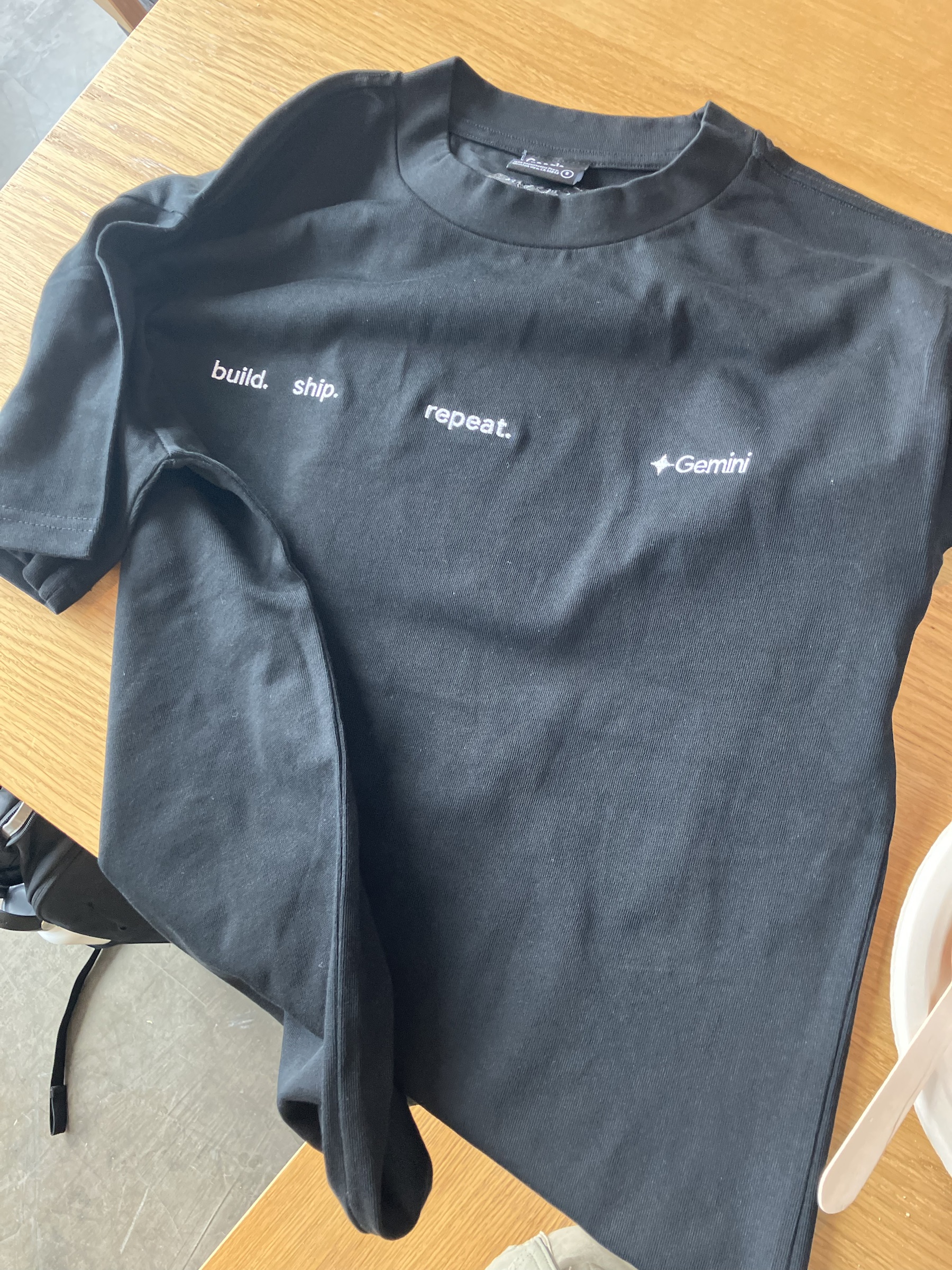
I also got Google merch which will be such a cool way to show my love and admiration for Google and Deepmind. I hope I can continue attending events, and build projects like this throughout college.
Here are some cool images, and vibe coding is so nice when you have a spanning view of the SF bay.
If anyone wants the full project here is the github: https://github.com/aravindkrishna2008/disaster-rescue
I would like to thank Cerebral Valley and Google Deepmind for this event. I hope I can come to future stuff like this. Maybe IO invite next year!?!?!